
01 — The Object
Heavier than you remember
It was white. Heavier than you remember, or heavier than you'd expect if you never held one. The kind of weight that pulled your coat pocket down on one side so you walked with a slight lean, like a ship listing to port.
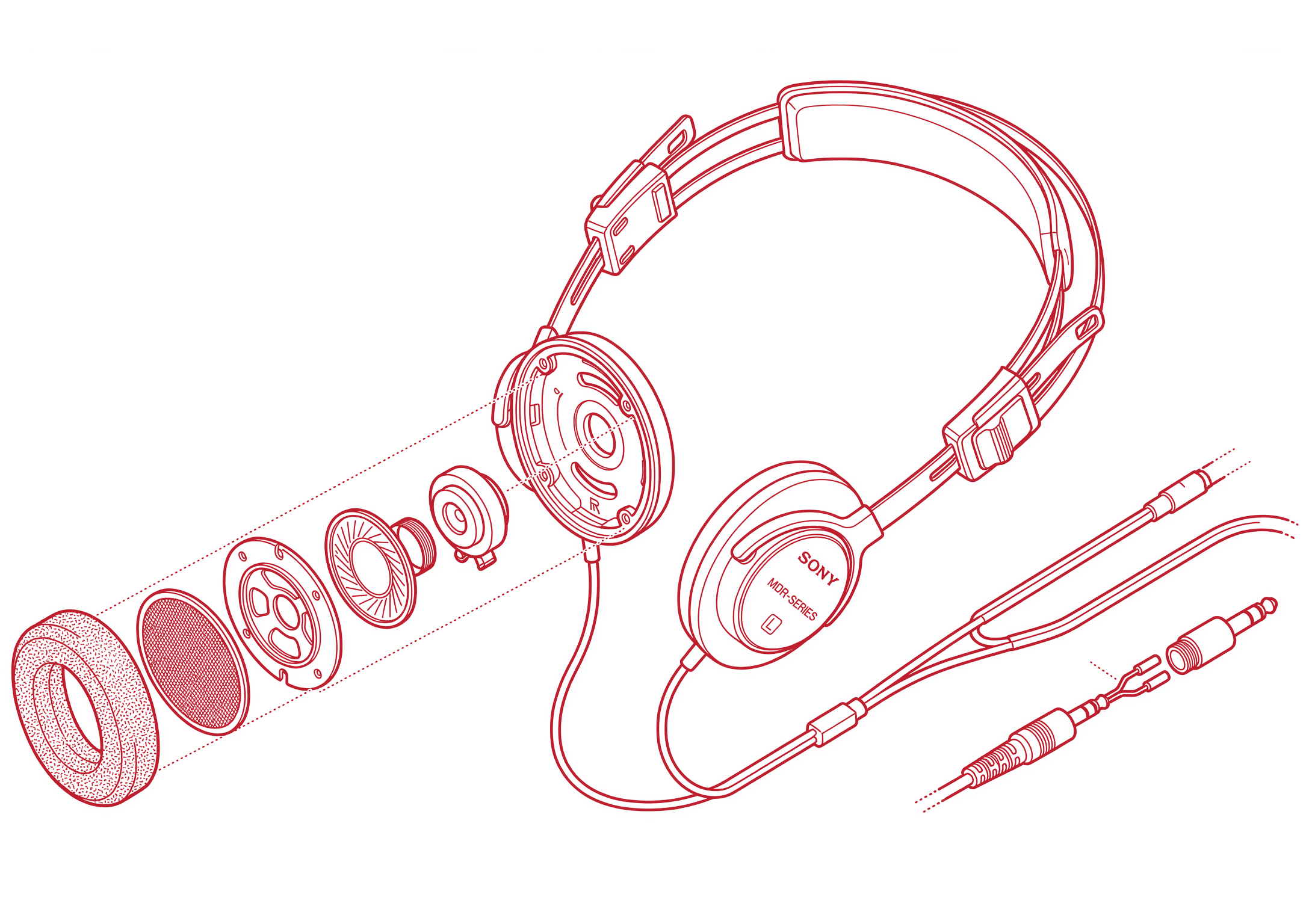
The chrome headband sat on top of your head with those oversized foam pads. Black, slightly coarse, the texture of a cheap sponge from under the kitchen sink. They didn't seal around your ears so much as rest against them. You could still hear the world if it shouted loud enough. But the point was that you didn't want to.
There was a mechanical click when you pressed play. Not a tap. Not a swipe. A physical, spring-loaded action that committed you to whatever was on the tape. You couldn't skip. You couldn't shuffle. You pressed play, and the machine decided the order. Or rather, whoever made the tape decided the order. If that was you, you'd already spent forty-five minutes with your finger hovering over the pause button on your hi-fi, timing the gap between tracks, making sure the levels didn't clip.
The hiss came first. That faint white noise before the music started, the sound of the tape itself, the oxide layer moving across the head. Then the first bar. And the world changed colour.

02 — The Chaos Moment
Three people, three stories, no agreement
The origin story of the Walkman depends on who you ask. And the fact that even the people who were in the room can't agree on how it started tells you something important about how innovation actually works.
In Akio Morita's telling, it started with him. In his autobiography Made in Japan (1986), Sony's co-founder describes wanting a small portable stereo player he could listen to music on during long flights. He saw a modified Pressman tape recorder that engineers had been tinkering with and decided it should become a product, over the objections of every marketing team in the building. This is the CEO's version. It centres the commercial visionary.
Nobutoshi Kihara, the engineer who actually built the prototype, remembers it differently. In his account, it was Masaru Ibuka, Sony's other co-founder, who started the whole thing. Ibuka was 71 years old and tired of carrying a heavy Sony TC-D5 tape recorder on trans-Pacific flights. He wanted to listen to opera without hauling luggage. He came to Kihara directly and asked him to build something lighter, playback only, stereo through headphones. In this version, Morita only saw the commercial potential after Kihara had already built the device.
Then there is Kozo Ohsone, the head of Sony's Tape Recorder Division, whose account positions his team as the driving force behind the development.
John Nathan, the American academic whose book Sony: The Private Life (1999) remains the most forensic account of the company ever published, presents all three accounts side by side and makes the case that the clean origin story is a simplification. Nathan speaks Japanese and was given access to Sony's archives and senior staff. His preface explains that an internal Sony memo had circulated suggesting the book was a company-sanctioned project — which it was not. Staff spoke with an openness Nathan had not anticipated, assuming they were on the record for an authorised history. That misunderstanding produced one of the most candid corporate books ever written. There was no single eureka moment. The Walkman emerged from a convergence of several people's needs, instincts and actions, and the tidy narrative each participant tells tends to centre the teller.
I find that more interesting than any single version. And more honest. Because if your theory of innovation requires a clean genesis story with one visionary and one lightning bolt moment, the evidence doesn't support it. What the evidence supports is something messier: overlapping frustrations, an engineer who could build things faster than most people could describe them, and a commercial instinct that overrode every piece of market research in the building.
There is a parallel story worth knowing. In 1972, seven years before the Walkman launched, a German-Brazilian inventor named Andreas Pavel strapped a modified tape player to his body and walked into the snowy woods near St. Moritz with his girlfriend. He pressed play. He later described the experience:
"What started put us in a state of ecstasy. We started feeling as if we were floating through the trees. It was unreal. Life became a film. A 3D film." Andreas Pavel
Pavel patented his device, the Stereobelt, in 1977. Sony would fight him in court for 25 years before settling for a multi-million dollar payout in 2003. The idea was in the air. Multiple people, in different countries, were arriving at the same need independently. That is not a single genius having a single breakthrough. That is a moment in time when the conditions were right and the people who noticed acted on it.
Small moments. Overlapping. Contested. And 385 million units later, still unresolved.
03 — The Engineer
The man Sony called "Mr. Walkman"
His name was Nobutoshi Kihara, and inside Sony they called him "Mr. Walkman." Outside Sony, almost nobody knows his name. That imbalance tells you something important about how innovation stories get told.
Nathan describes the Ibuka-Kihara relationship as "paradigmatic." Kihara was a mechanical engineer who applied for the job at Sony's predecessor company in April 1947, having already worked part-time assembling radios and phonographs. He recognised the company as the manufacturer of superior turntables and radio components. He was twenty years old. Over the following decades, he filed more than seven hundred patents.
By the time the Walkman brief reached him, that list already included Sony's first magnetic tape and tape recorder; its first transistor radio and transistor television; the world's first videotape recorder for commercial broadcast use; Betamax; 8mm video; and an entire catalogue of smaller, lighter variations on each. Nathan writes that "the innovations attributable to the Ibuka-Kihara team were the principal driver of Sony's growth from 1949 into the mid-seventies." (p. 26)
What made the partnership work was not seniority or hierarchy. It was a particular kind of listening. Nathan records Kihara explaining it in his own words: "Ibuka would say that a cassette version would be handier than a reel-to-reel, or that a smaller and lighter machine would be easier to use and easier to sell. He was always thinking out loud about something. And I was always listening." Kihara kept five or six experimental prototypes under his desk at any given time — models built on his own initiative, in spare moments, against no brief. When Ibuka would voice the idea aloud, Kihara would produce the prototype the following morning. "He'd be overjoyed," Kihara recalled. "'Kihara, this is just what I wanted!' And off we'd go again. He was like a happy kid at these moments, and I loved seeing him that way. As an engineer, that was my greatest pleasure." (pp. 25–26)
This is worth pausing on. The Walkman was not the product of a brief. It was the product of a habit — an engineer who never stopped building, anticipating a visionary who never stopped imagining. The meeting point between those two dispositions was, repeatedly, a new product category.
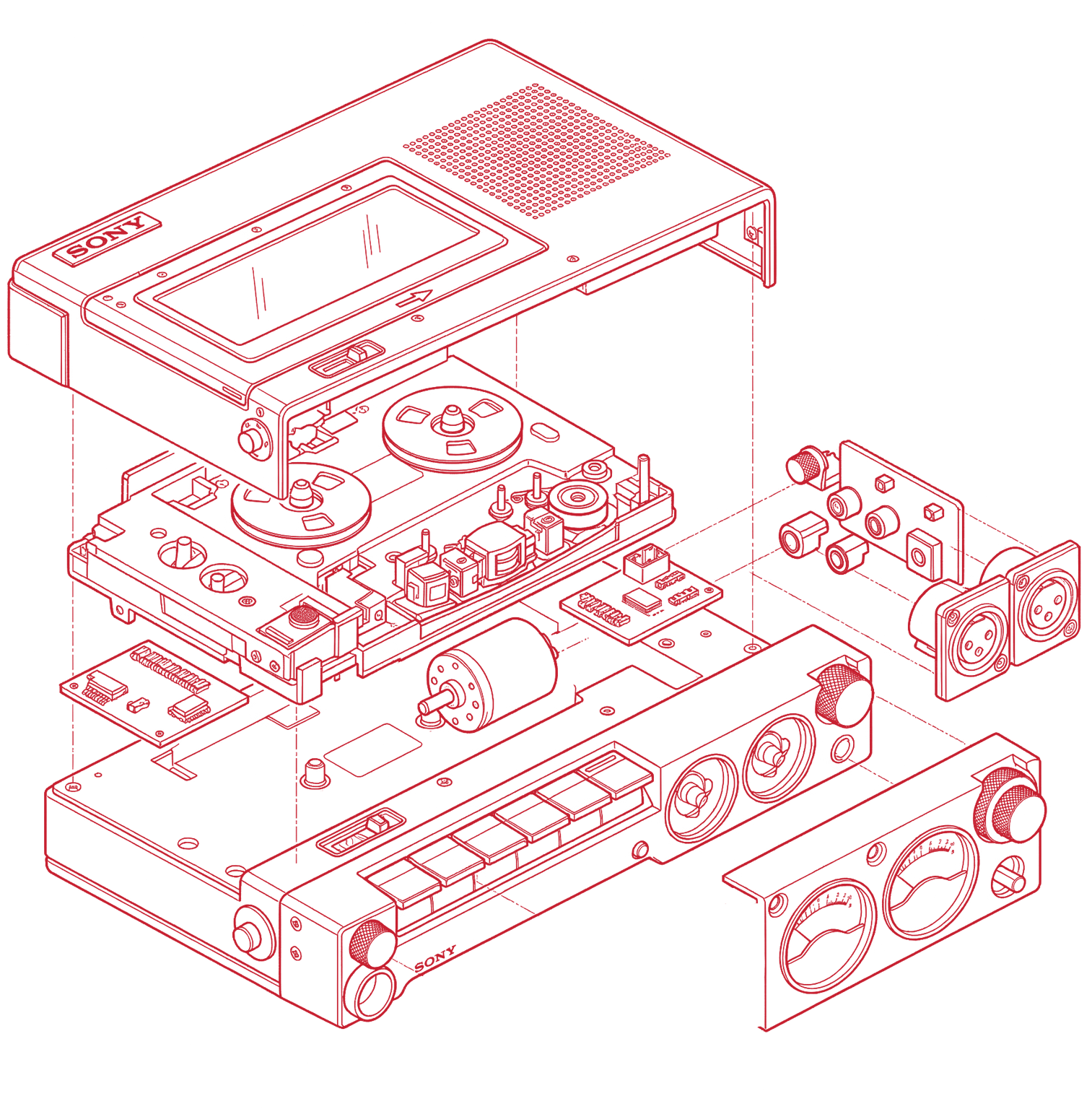
The Walkman itself began with the Sony Pressman, a monaural dictation recorder built for journalists. The brief was to make it portable, stereo, and playback-only. The recording circuit came out. The internal speaker came out. In their place: a stereo amplifier optimised for headphones. The surgery was precise — remove everything that adds weight and doesn't serve the listener, keep everything that does — and the team completed a working prototype in four days.
This is engineering in its purest form. Not addition. Subtraction. The Walkman wasn't built by adding features to an existing device. It was built by removing them until only the essential function remained: portable, private, high-fidelity stereo sound.
There was another critical engineering problem that most histories skip. The headphones. In 1979, headphones weighed 400 grams. They were designed for sitting in a chair in a quiet room, not for walking down a street. A separate Sony division developed lightweight headphones that weighed just 50 grams, those black foam pads on a chrome band that anyone who owned a Walkman can still feel on their head thirty years later. Without that parallel innovation, the Walkman stays in the laboratory. The device and the headphones were designed as a system. Neither works without the other.
The prototype was approved under unusual circumstances. Norio Ohga, who oversaw Sony's audio division, was in hospital with a broken back when the modified player was brought to him. He approved it from his hospital bed — and from there phoned CBS/Sony Records to arrange a selection of classical music tapes to be prepared for Ibuka before his flight. Ibuka was delighted with the sound. When he returned to Tokyo, he showed it to Morita, who took it home over the weekend. Nathan notes, without apparent irony, that all his life Sony's new products were Morita's favourite toys. By the time a prototype was ready for the production line, Ibuka had moved on to his next idea. Morita invariably claimed the first working model for himself.
Morita then added two modifications of his own: twin headphone outputs, so two people could listen to the same tape, and a button to reduce the volume for conversation without removing the headphones. Sony advertised this as the "Hotline function." It was an engineering solution to a social anxiety — that a personal music device would be seen as antisocial, a device that shut out the world. Consumers ignored it completely. They wanted the isolation. The Hotline feature was quietly dropped from later models.
Sometimes the engineer builds exactly what the user needs, and the user teaches the engineer what they actually wanted.
04 — Phil's Story
My first tape was Roxette, Look Sharp!
I was ten. Late eighties. I got my Walkman before I got my first hi-fi, before those stacking component units that deserve their own article, and it arrived in my life the way all the important things did: without ceremony, total impact.
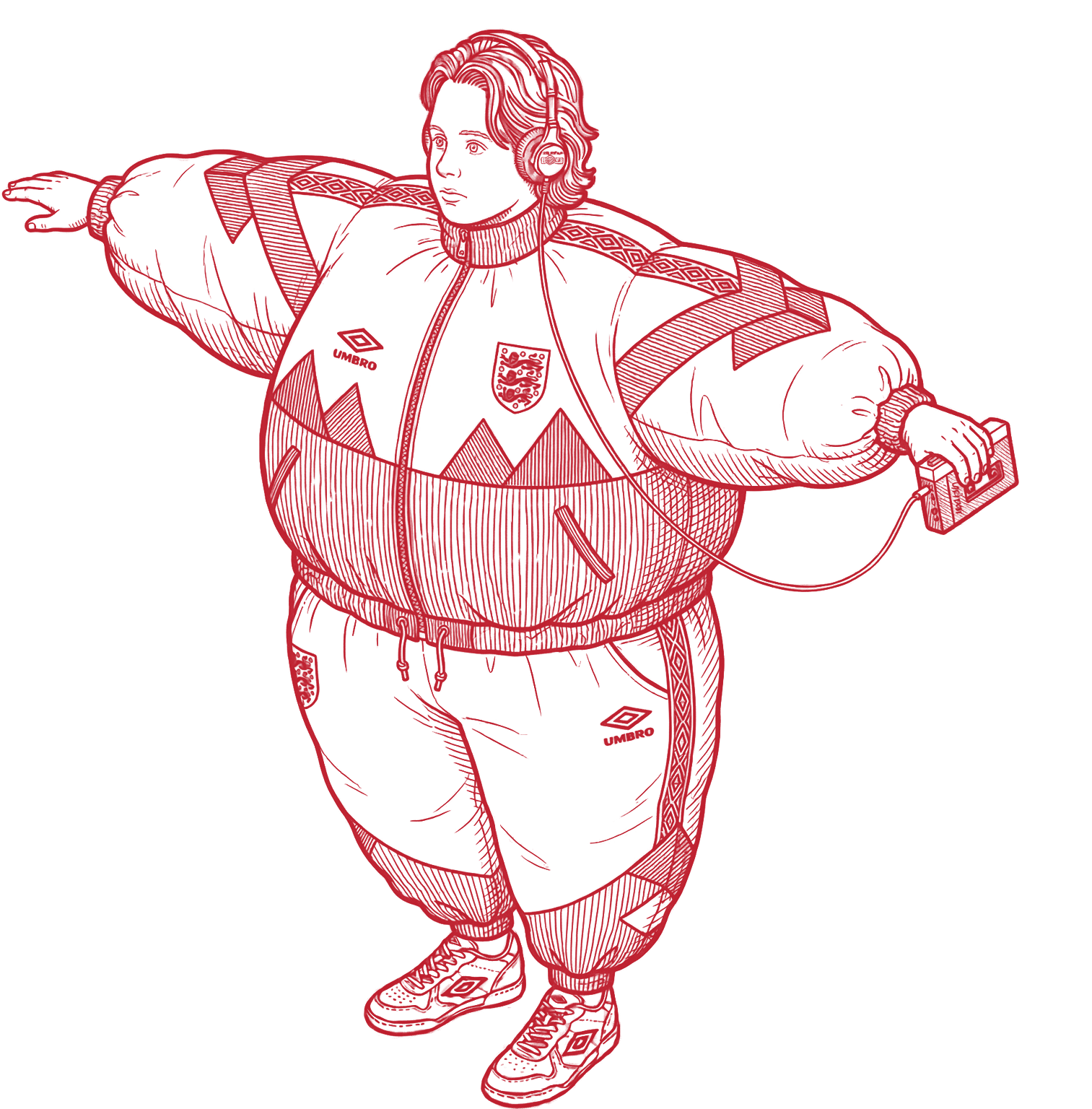
My first tape was Roxette, Look Sharp! And I need to set the scene properly here. I was wearing a replica England shell suit. If you don't remember shell suits, they were made of a material that rustled when you breathed and inflated in the wind like a lilo. Not dressed for success at ten years old. But it was the eighties, and nobody was.
The demoralising moment when the batteries died mid-walk, the music slowing down, the pitch dropping, Roxette turning into something underwater, that was a regular occurrence. You learned to carry spares. You learned to budget for Duracells.
But here's what mattered. It was mine. The playlist was mine. No cheesy DJ. No random advert about carpets. I chose what played and in what order, and that was a form of control I hadn't experienced before. At ten years old, you don't control much. Someone else decides what time you eat, where you go, what you watch. The Walkman was the first device that said: this is your world now. Press play.
And the noise. I should explain this. I'm someone who processes everything. I hear conversations in stereo, both my kids talking to me at the same time, and I'm tracking both threads. I pick up every micro sound in a room without trying. I don't mean to eavesdrop, but my brain captures it all. It's a sensitivity to stimulus that is, depending on the context, a gift or an assault.
The Walkman was a filter. The first one I'd ever found. Headphones on, play pressed, and the world dialled down to one signal. One frequency. One story being told in the order it was meant to be heard. For someone wired like me, that wasn't entertainment. It was relief.
Years later, bouncing down a street to Oasis, "Supersonic", feeling like ten men. Waiting for the bus, Michael Jackson's Thriller making the wait irrelevant. Peering through the space you'd wiped in the condensation on a window, "November Rain" playing after a breakup, the kind of moment where the music and the weather and the feeling are all the same thing.
The devices changed. The Discman replaced the Walkman. The iPod replaced the Discman. The phone replaced the iPod. But the essential act never did: a portable device, headphones on, the outside world turned down so the inside world can breathe. I still reach for that filter every day. Audiobooks, podcasts, new releases every Friday. It was better when it was Monday, actually. New singles and albums hitting the shops. Jumbo Records in Leeds, where I'm from. HMV when Jumbo didn't have it. There was a ritual to it. The physical act of going somewhere to find the thing you wanted to hear.
The Walkman was the first personal technology device I truly loved. Not for what it did technically. For what it made possible emotionally.
05 — The Go-to-Market
How Sony sold a product nobody asked for
Here is where the Walkman story gets most useful if your job is marketing. And here is where Nathan's book becomes essential reading, because he details what may be one of the most unorthodox launch strategies in corporate history. What follows draws primarily from Chapter 6 of Sony: The Private Life (pp. 150–158, 1999 Houghton Mifflin edition).
The internal resistance was fierce. Most executives believed a tape player that couldn't record would be a "disastrous failure." Morita overruled them, took personal responsibility for the product, and set a first-run target of 30,000 units — a number his own engineers considered beyond imagining. (p. 153)
The conviction driving that decision was Morita's consistent belief that consumers cannot tell you what they want before they have seen it. You have to show them first.
Morita's pricing decision crystallised that conviction. He insisted the Walkman must be affordable to teenagers, and declared a price of 33,000 yen — around $125 at the time — explaining with a smile that 1979 was Sony's thirty-third anniversary. The Pressman, the device the Walkman was derived from, sold for $400. Design engineers warned him that a first run of at least 30,000 units would be needed to hit that price through economies of scale. Sony's most popular tape recorder was selling 15,000 units a month. A 30,000-unit first run for an unproven product was, in their words, beyond imagining. Morita didn't flinch. (p. 152)
There was a second objection that had nothing to do with engineering. In Japan at the time, anything worn in the ear — including headphones — was culturally associated with hearing impairment. Deafness was a taboo subject. The word itself had been banned from use in newspapers and magazines. Morita's answer was direct: Sony would create a new fashion. A "headphone culture." (p. 154)
The launch strategy broke several rules that were considered fundamental to consumer electronics marketing at the time.
No advertising at launch. Morita believed the product was too revolutionary for traditional ads. He didn't want to explain the technology. He wanted people to witness it.
On June 22, 1979, Sony held what they called a "press conference" that was actually a field trip. Journalists were taken by bus to Yoyogi Park. Instead of a speech, they were handed TPS-L2 units and told to press play. Nathan describes what followed: Sony staffers and models demonstrated how to enjoy the Walkman on roller skates, skateboards, and riding a tandem bicycle on a date. The product explained itself through itself. That is a sentence worth sitting with if you market anything. (p. 155)
The Ginza strategy. To spark grassroots demand, Sony sent young, stylish employees into the high-traffic Ginza district. They were instructed to simply walk around wearing the device. When curious strangers approached, they wouldn't give a sales pitch. They would take off their own headphones, put them on the stranger, and let the music do the talking. (p. 156)

"In every case the images reinforced the notion that the Walkman and its stylish headphones were a fashion statement." John Nathan, Sony: The Private Life, p. 157
Lifestyle influencers, not technical reviewers. Sony intentionally bypassed tech-heavy hi-fi magazines, putting units into the hands of cultural figures rather than electronics journalists — deliberately moving the Walkman out of the electronics category and into the culture category. (p. 157)
The most striking example: Nathan records that Walkmans were given as gifts to musicians in the Berlin and New York Philharmonic orchestras. The response from the classical music world gave the device artistic credibility that no spec sheet could have delivered. A technical reviewer would have seen a low-fidelity portable tape player. A conductor heard something else entirely.
Nathan describes the psychological effect of the device: you were physically in a public space but mentally somewhere private, somewhere else. Sociologists would later call this the "Walkman Effect." It was the first time a consumer device gave an individual that level of control over their sensory environment in the middle of a city.
The name itself. And here is one of my favourite details from Nathan's account. "Walkman" was Japanese English, and Morita knew it. He approved a suggestion from the advertising department that the product should be sold under different names in different markets: "Sound-About" in the United States, "Stowaway" in Britain. Names that were grammatically correct. Names that described what the product did. None of them created a category.
But all summer and autumn, tourists and airline flight crews had been buying Walkmans in Japan and carrying them home. By November, Morita was being besieged by friends in New York, London, and Paris asking how they could get one. He telephoned from Paris and told Ohsone: the product would be called "Walkman" everywhere. The name wasn't changed by a branding decision. It was decided by people who wanted one. (p. 154)
The first month was brutal. The Walkman launched in Japan on July 17, 1979 — more than three weeks behind Morita's deadline. Nathan's description of what followed is blunt: for a stomach-churning month, nothing happened. Then from mid-August, dealers had trouble keeping their shelves stocked. The first 30,000 units were gone by the middle of September. (p. 154)
Retailers who had refused to stock it were calling Sony begging for inventory. Within a year, Walkmans had waiting lists at department stores across Tokyo, New York, and London.
Nathan describes the advertising imagery that followed once word of mouth had done its work. The first Tokyo launch poster featured a tall, leggy American girl in leotard and heels, her left arm thrown exuberantly upward as she grooved to her Walkman. Just behind her stood an elderly Japanese Buddhist monk in summer kimono — on his shaved head, a pair of clunky old-fashioned headphones. Old world and new world, in a single frame. The entire go-to-market condensed into a single image. (p. 157)
What this reveals about marketing a new category. You cannot advertise your way into a market that doesn't exist yet. Traditional marketing assumes the customer already has a frame of reference for what you are selling. When they don't, advertising creates confusion. Sony's approach was to let the experience do the work. Get the product into the hands of people who would naturally talk about it. Let them create the frame of reference for everyone else.
This contrasts sharply with how most new products launch today. The default playbook is: build awareness through paid media, drive consideration through content, convert through performance marketing. That works when the category already exists. When it doesn't, that funnel has nothing to funnel into. The customer doesn't know they have the problem you are solving, so your awareness campaign is noise.
The Walkman playbook was different. Seed the experience with a small number of the right people. Let the product create its own word of mouth. Use price not as margin protection but as category definition. Refuse to compromise the positioning to make it easier to explain. And when the founder's own instinct is wrong on the name, let the market correct him.
06 — The Cultural Chain
385 million units and one word in the dictionary
The Walkman created the concept of a personal soundtrack. The idea that you could impose your own emotional atmosphere onto a public space. Walking through a city with music playing was a fundamentally different experience to walking through a city in silence. You were in the same place as everyone else, but you were somewhere else entirely. Sociologists called it the "Walkman Effect." It was the first time a consumer device gave an individual that level of control over their sensory environment.
By 1983, pre-recorded cassettes outsold vinyl records for the first time, driven overwhelmingly by portable players. The Walkman didn't just ride the cassette wave. It created it.
The device entered the fitness revolution. Between 1987 and 1997, the number of people who reported walking for exercise increased by 30 percent. The Walkman made movement bearable, then enjoyable, then essential. It is not an exaggeration to say that the aerobics boom of the 1980s and the jogging culture of the 1990s owe a material debt to a playback-only cassette player.
The word "Walkman" entered the Oxford English Dictionary in 1986. It became a genericised trademark. Any portable stereo was a Walkman, regardless of who made it. That kind of linguistic permanence is the rarest marker of cultural penetration.
And the chain doesn't stop. The Walkman proved a thesis: consumers want miniaturised, personal, portable technology. That thesis led to the Discman. The Discman led to the MP3 player. The MP3 player led to the iPod. The iPod led to the iPhone. Every device in that lineage inherits its fundamental assumption from a set of overlapping frustrations, an engineer who could prototype faster than most people could brief, and a commercial conviction that overrode every piece of data in the building.
The smartphone you are probably reading this on is a direct descendant of a cassette player that couldn't record.
07 — The Principle
What the Walkman teaches about conviction
The Back-Engineering Principle
Lead the market. Don't ask it.
Nathan's account of Morita's approach returns to a consistent theme: the conviction that consumers cannot envision what they have never seen, and that it is the manufacturer's job — not the market researcher's — to show them.
This is not an argument against listening to customers. It's an argument against asking them to do your job. Customers can tell you what frustrates them. They can tell you where the friction is. They cannot tell you what the solution looks like. That requires an act of imagination followed by an act of engineering, and the courage to back both with your own reputation.
The Walkman didn't come from the centre of the bell curve. It came from overlapping frustrations, an engineer who closed his eyes and imagined what a jogger needed, and a commercial leader who trusted his instinct over his data. The edges. Always the edges.
The people who create new categories do not do so by asking the middle what it wants. They observe, they imagine, they build, and then they show the world something it didn't know it needed.
If you wait for the research to confirm the idea, someone with less data and more conviction will have already shipped it.
If this sparked something, I'd like to hear about it. Drop me a line.
Stay in the loop
Get the next Back-Engineering article by email. No spam, no fluff, just the next device when it's ready.
Sources & Further Reading
- Nathan, J. (1999) Sony: The Private Life, Houghton Mifflin. Chapters 5–6. Buy the book
- Morita, A. with Reingold, E.M. and Shimomura, M. (1986) Made in Japan: Akio Morita and Sony, E.P. Dutton. Buy the book
All direct quotes marked as draft pending verification against the original texts. Page numbers refer to the 1999 Houghton Mifflin edition of Nathan.