
DTC ECOMMERCE — TOOL 01
Product Information Management for DTC Brands
If you sell products, you already have product information. Most businesses manage it badly. It lives in platform dashboards, spreadsheets, emails, and people's heads. This is the system I built to fix that problem in my own business. You can copy it free.
Version 1 — Live
This is a live tool being built and iterated on a real business. Version one solves the problems that exist today. As the business grows, so does the tool. Each new problem becomes the next version.
Start with your business. Start with where a product begins.
I make drawings. Each one starts in a sketchbook with a number, a date, and a story. That drawing becomes a scan. The scan gets cleaned up and becomes a print. The print comes in different sizes, on specific paper, with a cost to produce, a price to sell, and in some cases a certificate with two unique serial numbers. All of that information needs to live somewhere before a product can go on sale.
That is where a product begins in my business. Your business will start somewhere different. A supplier quote. A product brief. A sample approval. But the question is the same for every business: where does a product come from, and what information does it carry as it moves toward a customer?
Most product management software is built for the average business. You buy the platform, then spend months trying to bend it to fit. Fields you do not need. Fields you need that are not there. This tool was built the other way round — starting with the specific realities of one business, then made generic enough for you to adapt to yours.
Version one covers five stages: the original artwork, the production file sent to the printer, the product as it is sold, the variant with its costs and margin, and image references. Each stage feeds the next. The tool is also designed for where this business is heading. As AI becomes part of day-to-day operations — automatically logging new work, building product records from images, feeding content into social channels — the same records that run this spreadsheet become the information those tools work from.
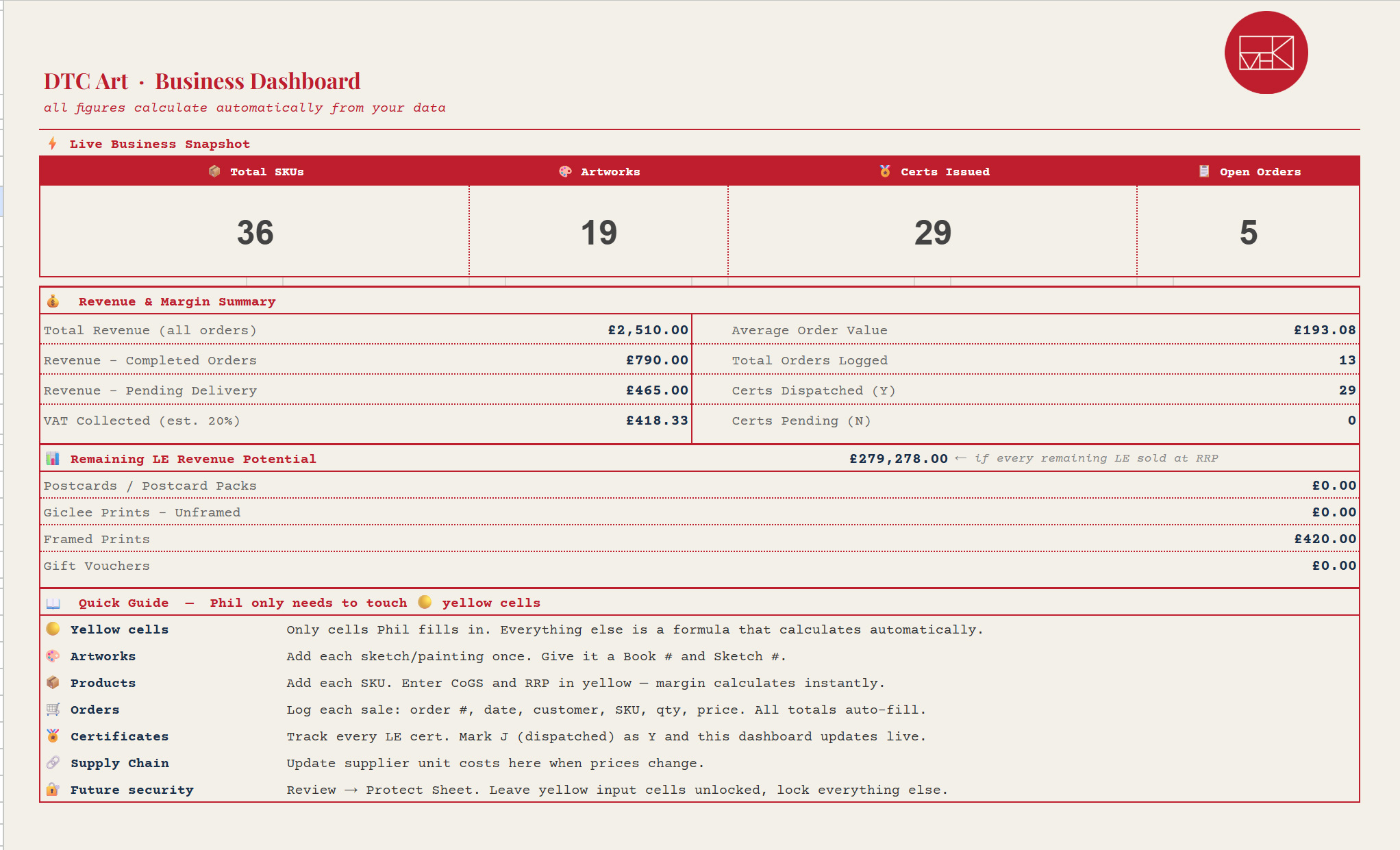
The next layer: a provenance record for every individual limited edition print. Edition number, both hologram serial numbers, buyer, sale date, sale channel. One row per print sold. The record that protects a collector's investment long after the sale.
Product listing data structured and ready to push to Shopify. Titles, descriptions, variants, pricing — built from the records that already exist in the sheet. One source of truth feeding the storefront directly.
What is a PIM?
PIM stands for Product Information Management. It is the single place where everything about your products lives: prices, descriptions, stock levels, cost of goods, images, variants, edition details.
For a DTC brand, that information tends to live in too many places at once. Your ecommerce platform. Your supplier files. Your pricing labels. Your head. It gets out of sync. A price gets updated in one place and forgotten in another. A product sells out but your tracking does not reflect it.
A PIM fixes that. One place, one update, accurate everywhere.
You do not need expensive software to build one. This is a Google Sheet.
Who this is for
DTC founders and MDs who are managing product information manually, across spreadsheets, platform dashboards, and email threads, and feeling the friction of it.
Specifically useful if you:
- Sell across more than one channel (ecommerce + trade, or ecommerce + events)
- Need to track CoGS and margin alongside product data
- Have product variants, limited editions, or tiered pricing
- Are paying for platform tools that don't quite fit your business
Five tabs. One source of truth. Zero monthly cost.
The Problem
Two channels. One product. No single truth.
I run philmckeith.art, a limited edition print and original artwork brand. Products sell through two channels: an ecommerce store and in-person art shows with physical pricing labels.
Every product has variables. Price, cost of goods, stock count, title, description, edition details, paper type. That information needs to be identical everywhere it appears.
Without a central system, prices got out of sync. I had no live view of margin. I was re-entering data between systems and chasing accuracy instead of making decisions.
The Objective
One source of truth — built for the way this business works.
A single system that tracks every product variable in one place: RRP, CoGS, edition details, paper type, descriptions, image references. Updated once, accurate everywhere.
The database needed to serve both channels without duplication. In-person shows pull pricing from the same source as the ecommerce store. No manual syncing. No version drift.
The critical word is this. Every product business has different information to track. The tool on this page was built for a limited edition print business and reflects that specific reality. Your business will have different stages, different fields, different sources of truth. The process of asking those questions first is what makes the difference. Build the structure around your business, not the other way round.
This tool is part of the DTC Ecommerce OS programme — a set of working tools and frameworks built on real businesses. Each one addresses a specific operational problem.